
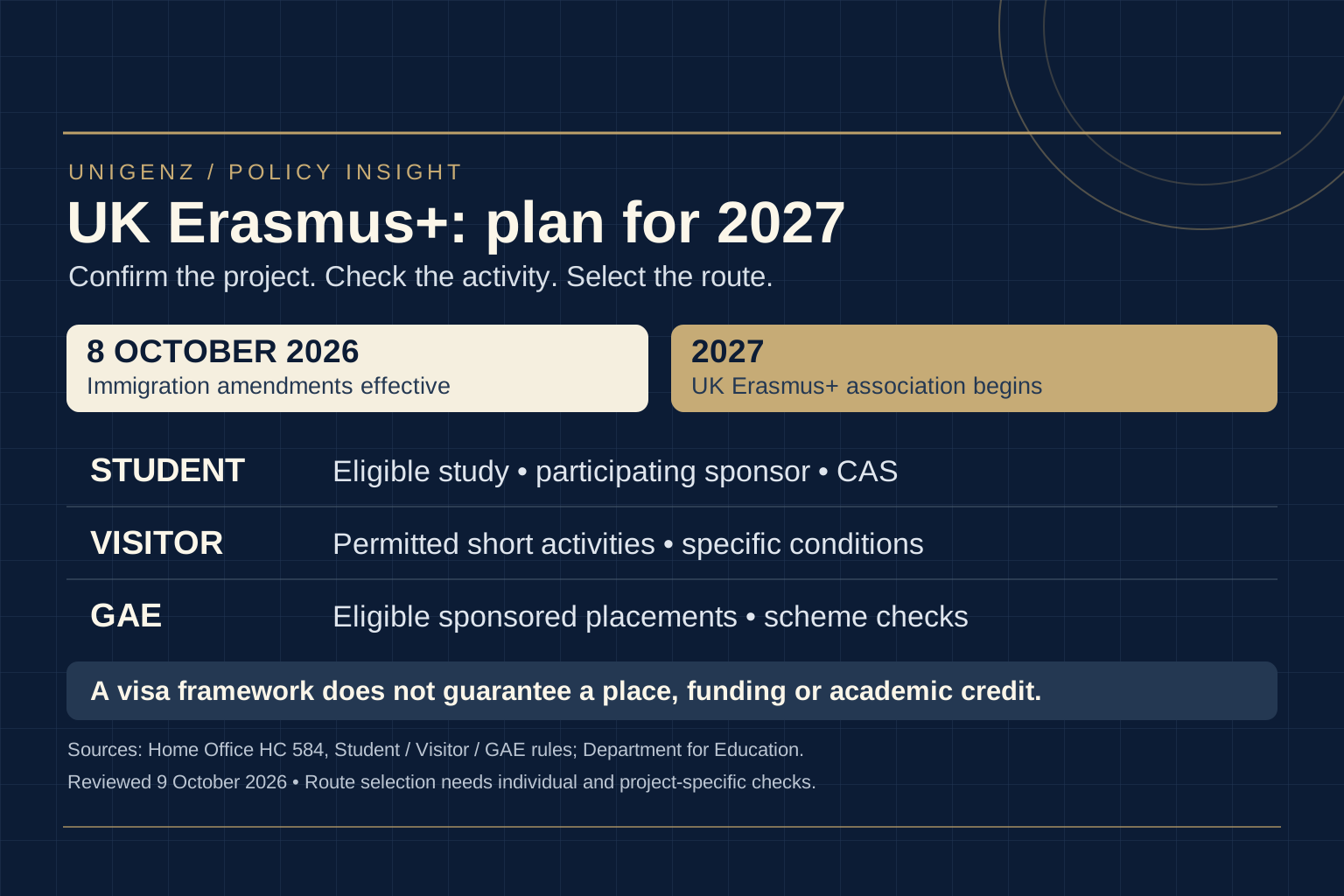
What changed, who is affected, and what to do next
The UK brought Erasmus+ immigration amendments into effect on 8 October 2026. They accommodate genuine programme participants across study, short visits and eligible sponsored placements. The relevant Statement of Changes, HC 584, was published on 3 September; this week's development is implementation, not a newly announced programme. Applications made before 8 October fall under the stated transitional provisions and are assessed against the earlier rules.
The immediate planning audience is students and institutions preparing eligible mobility projects, especially for 2027. Ordinary applicants buying a complete UK degree should not assume that these provisions apply to them. Start by obtaining a written description of the proposed exchange, its participating organisations and its intended immigration route. Only then assess whether the opportunity deserves a place in your academic and financial plan.
Keep the immigration date separate from the programme date
The UK and EU finalised the agreement for UK association with Erasmus+ in April 2026, with association from 2027. Updating immigration rules in October prepares the legal framework; it does not establish that a particular university has opened applications, received funding or agreed to host your exchange. Those are separate institutional decisions.
For a 2027 applicant, record four dates: the project or funding call, your institution's nomination deadline, the mobility start date and the immigration application date. A useful opportunity can become impractical if nomination arrives after housing commitments, credit approval or visa preparation must begin. Ask the international office for the programme-specific calendar rather than relying on a national announcement.
For non-EU students, test the opportunity rather than the label
The European Commission says non-EU participation varies by opportunity. Students from other non-EU countries can access some activities, including international exchanges where their university participates. This is not universal eligibility for every Erasmus+ placement, and an Erasmus Mundus degree is not interchangeable with a semester exchange.
For an Indian student, the practical questions are therefore institutional: does your university participate in this project, does the agreement cover your department and study level, and can it nominate someone in your circumstances? Request the specific eligibility conditions and selection process. An agent's general claim that Erasmus+ is 'open to international students' is too broad to justify paying a deposit or changing a university shortlist.
Student-route changes: more flexibility for genuine mobility
Appendix Student now expressly includes Erasmus+ study at participating sponsors. The normal approved-qualification requirement has a targeted exception, and relevant Erasmus+ courses can qualify at RQF level 2 or above in England, Wales and Northern Ireland, or SCQF level 5 or above in Scotland. Eligible Erasmus+ work placements are exempt from the usual placement-duration restrictions; placements must still be assessed as integral to the course. These provisions are specific to genuine programme participation.
The rest of the route still matters, including a valid Confirmation of Acceptance for Studies, English-language and financial requirements, and any applicable nationality or subject restrictions. Ask the sponsor to confirm how your course and placement satisfy the rules. Greater placement flexibility is not permission to replace an educational programme with an unrelated job.
A short visit is not automatically a work placement
Visitor provisions can accommodate qualifying Erasmus+ activities, including study and defined training or observation activities. The permitted-activities rules narrowly define these permissions: job shadowing must remain participative observation and must not fill a permanent role. The new traineeship permission is age-limited and capped at 30 days; it is not a general adult-internship route.
For study as a visitor, the usual course-duration limit is six months, and the accredited host must participate in Erasmus+ where the Erasmus+ provision is used. The visitor rules also require genuine temporary intentions and adequate support for the visit. Classify the actual daily activity, not the title on the invitation: 'learning experience' can describe either observation or productive work, with very different immigration consequences.
For eligible work experience, check the GAE scheme
The Government Authorised Exchange scheme list now contains Erasmus+ for eligible traineeships, teaching placements and training assignments. It names IRARA Services Ltd as the overarching body and sets a maximum 12-month work-experience programme. Other placement types use alternative routes; the scheme entry does not approve every internship offered by a UK organisation.
GAE applications require licensed sponsorship and the relevant reference, together with the other route requirements. Ask who will issue it and whether the proposed duties match the approved scheme. A host's acceptance email and an immigration sponsorship reference serve different purposes. Resolve that distinction before booking travel or promising a start date to a placement supervisor.
Programme fit: what must an exchange actually add?
Our planning recommendation is to assess mobility as an extension of the home degree. For engineering or computing, specify the laboratory, project methods and technical outputs you will access. For economics or business, identify the modules and assessment that deepen an existing concentration. For arts and social sciences, establish the collections, fieldwork or supervised research that justify the move. A country name alone is a weak educational objective.
Get credit recognition in writing before departure: modules, workload, assessment, grade conversion and the consequence of failing or changing a module. A valuable placement can still delay graduation if it replaces required teaching without equivalent credit. Ask who approves changes during the exchange and how quickly they can respond when a timetable or supervisor changes.
Consider a hypothetical engineering student offered a semester combining a specialist module with a supervised industry project. The decision should depend on access, credit and the documented activity, not on the Erasmus+ logo. Compare it with staying home and completing a substantial research project. The exchange should deliver an identifiable advantage after its costs and disruption are included.
Build the budget around confirmed support
The Department for Education describes Erasmus+ funding as project-based support that can cover items such as travel, living expenses and visa costs. Its overview says the next funding round is expected to open in November 2026 and close in February 2027, with exact dates to be confirmed in the 2027 Programme Guide. Treat that as an indicative institutional funding timetable, not your personal application deadline or an award guarantee.
Our recommendation is to budget the exchange without assumed employment income. Add accommodation deposits, insurance, immigration costs, travel, currency movement and any fees retained by the home institution. Then subtract only support confirmed in writing, with its payment date. Even an adequate eventual grant can leave a cash shortfall if rent and travel are due first.
Test a delayed-funding scenario and an early-return scenario. Who covers a cancelled placement, a changed start date or accommodation that cannot be refunded? Keep the decision affordable if the grant is smaller than expected. Funding eligibility, receipt of funding and immigration financial evidence are separate checks; one should never be used as a vague substitute for another.
Use a decision file with four gates
We recommend a short decision file that a student, parent and international-office adviser can review together. Keep one version of the proposed activity and ensure the acceptance letter, learning agreement, funding evidence and immigration description are consistent. The file should make unresolved points visible instead of hiding them behind a reassuring programme name.
- Project gate: a named eligible mobility project, participating home and host organisations, and written selection or nomination conditions.
- Academic gate: approved modules or duties, supervision, assessment, credit recognition and a workable return-to-study plan.
- Immigration gate: the correct route for the actual activity, required sponsorship or visitor evidence, and an application calendar checked against current rules.
- Financial gate: full costs, confirmed support, payment timing and a funded contingency if the exchange changes.
Common failure modes to resolve before committing
The first failure is treating legal eligibility as an available place. A rule can permit participation while the relevant partnership has no funded slots. The second is assuming that a six-month visit permits any internship. Duration is only one test; duties and route-specific conditions matter. The third is paying for an attractive mobility offer before the home department agrees to recognise it.
A fourth failure is building a budget around an unconfirmed grant or future earnings. A fifth is using a short exchange as an assumed pathway to graduate work rights. These amendments do not themselves establish eligibility for the Graduate route. Assess any later immigration objective independently, using the rules for that route and the qualification actually completed.
Finally, avoid compressing all October changes into one start date. HC 584 separately schedules its Student maintenance amendments for 30 November 2026. Verify the financial rules applicable when you apply; the 8 October Erasmus+ implementation does not bring every amendment in that statement into force at once.
Your next steps this week
Begin with one realistic opportunity. Ask the home international office whether your department has a suitable 2027 project or is preparing one. Request its eligibility, nomination and funding timetable, and obtain the host's activity description. If it remains speculative, label it as a possibility rather than a guaranteed feature of the degree.
Next, arrange academic approval and route review in parallel. Produce a one-page budget showing when money is needed, not merely the total award advertised. Set a decision deadline before non-refundable commitments. The strongest plan is one you can explain coherently: what you will learn, why that host matters, how it contributes to graduation, and how the permitted activity and confirmed resources make participation feasible.
Questions applicants are asking
Does the October change mean I can start a UK Erasmus+ placement immediately? No automatic place follows from a visa-rule amendment. UK programme association is from 2027, and your institution must confirm the relevant project and its timetable.
Can an Indian student participate? Some non-EU opportunities exist, but eligibility depends on the specific action and participating institutions. Get a written answer for your project and study level.
Does a short placement guarantee academic credit or a later UK job? No. Credit recognition needs separate academic agreement; these immigration changes do not guarantee employment. Evaluate the educational outcome and any later work route independently.
What should I obtain before paying? Written project eligibility, an accurate activity and route description, academic recognition, and a realistic budget supported by confirmed funding. If one is unresolved, identify it as a condition rather than assuming it will be solved after payment.
Admissions, visa and immigration rules can change. Always verify time-sensitive requirements on the relevant government and university websites before acting.
Primary sources reviewed
Official references
- Home Office — HC 584 implementation and amendments (published 3 September 2026)
- Home Office — Immigration Rules update log (8 October 2026)
- UK Government — UK–EU Erasmus+ agreement (15 April 2026)
- European Commission — Erasmus+ opportunities for non-EU participants
- Home Office — Appendix Student, ST 7–17
- Home Office — Appendix Visitor: Permitted Activities, PA 20
- Home Office — Appendix V: Visitor, V 4 and V 9
- Home Office — Erasmus+ Government Authorised Exchange scheme entry
- UKVI — Government Authorised Exchange visa overview
- Department for Education — Erasmus+ programme overview and funding timetable
- UKVI — Graduate visa eligibility
Information reviewed on 9 October 2026. Time-sensitive rules should be checked again before application, deposit and enrolment.