
What changed this week, and who should act
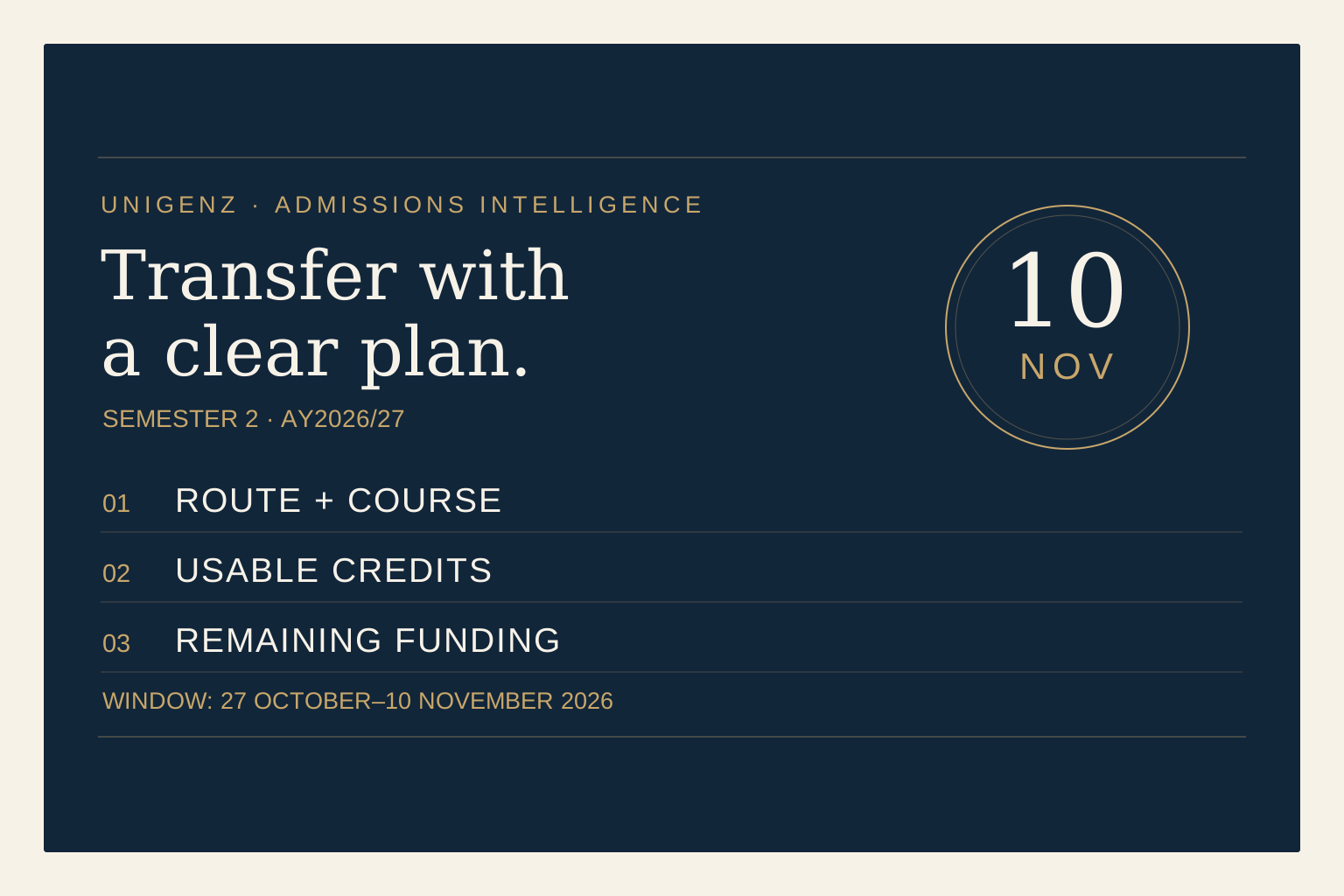
NUS's AY2026/27 Semester 2 transfer window opened on 27 October 2026 at 10am Singapore time and closes on 10 November. On our 30 October source review, its admissions calendar marked the window open. This is an application-cycle development, not evidence of a new transfer policy. The published cycle covers current undergraduates at Singapore's autonomous universities and current overseas-university undergraduates who are Singapore Citizens or Permanent Residents.
The immediate task is to establish the correct applicant category before preparing a transfer case. For an international student already studying at a Singapore autonomous university, the window may be relevant. For an international student at an overseas university, the current Semester 2 calendar does not list their cohort. A general transfer category elsewhere on the website should not be read as permission to use every transfer intake. Source review: 30 October 2026.
Separate general eligibility from this intake’s eligibility
NUS's general eligibility chart, dated 28 October 2024, remains linked from the transfer page. It distinguishes local autonomous-university students from overseas-university students, then considers citizenship and school qualification. International students at overseas universities presenting an IB Diploma, Singapore-Cambridge A-levels, a Singapore polytechnic diploma or NUS High School Diploma can fall under the general transfer category. Other international school qualifications are directed to the international-qualifications route.
That chart explains classification; the current calendar determines which cohorts are listed for this intake. Consider three examples. An Indian national currently at NTU should investigate the autonomous-university route. An Indian national studying in India with CBSE should examine the international-qualifications application instead. An international IB graduate now at a British university should not infer Semester 2 eligibility merely because the general chart places that qualification under transfer. Obtain clarification from NUS Admissions before selecting a route.
For international qualifications other than IB, the current admissions calendar lists 16 December 2026–17 February 2027 for AY2027/28 undergraduate applications. That is a separate exercise. Do not describe it as a guaranteed advanced-entry opportunity or assume previous university study will automatically shorten the degree.
Remove unavailable programmes before writing an application
NUS excludes Architecture, Dentistry, Industrial Design, Landscape Architecture, Law, Medicine, Nursing, Nursing (CCP-RN Degree) and Pharmacy from the current academic year's Semester 2 transfer exercise. This restriction can settle the question before grades, essays or credit mapping become relevant. It should not be interpreted as a permanent ban across all future admission exercises.
For other programmes, check the prerequisites corresponding to the school qualification you actually hold. NUS explicitly tells transfer applicants to use the qualification-specific prerequisite information. A year at university does not justify assuming that an unmet school-level condition has disappeared. If the qualification or subject combination is unusual, ask for a written assessment instead of borrowing another qualification's rule.
Programme names also need careful reading. An interest in technology might lead to Computer Science, Business Analytics, an engineering programme or a business degree with an analytical major. These are different curricula and career preparations. Our recommendation is to identify the academic problem the transfer would solve, then choose the programme that addresses it rather than the nearest prestigious label.
Test the curriculum, not just the university name
The AY2026/27 School of Computing bulletin illustrates the difference. Computer Science includes programming, discrete structures, calculus, linear algebra and probability/statistics. Business Analytics includes mathematical preparation alongside econometrics modelling, data management, programming and algorithms. These published curricula are background for evaluating fit, not newly announced requirements this week.
NUS Business School's AY2026/27-onwards BBA curriculum, meanwhile, includes Accounting for Decision Makers, Principles of Marketing, Organisational Behaviour, Programming for Business Analytics and AI, Operations and Technology Management, and Finance. An applicant primarily seeking business decision-making should compare that structure with the more technically intensive analytics pathway. Sharing the word 'analytics' does not make two degrees interchangeable.
Build a short module map with three columns: what you have already studied, what the target degree requires, and evidence of equivalent depth. A programming module should be compared through learning outcomes and assessed work, not its title alone. For engineering, add laboratory and design content; for business, distinguish introductory survey courses from major-level requirements. This is our planning method, not a promise of exemptions.
Make the transfer explanation academically defensible
NUS asks for an acceptable school qualification, relevant programme prerequisites and a short explanation of the motivation for transfer. Its assessment considers school results, university performance and other academic and non-academic achievements in competition with eligible applicants. Interviews may be requested. No automatic transfer score or guaranteed admission threshold is stated in that guidance.
Our recommendation is to write around an identified educational need: a specialisation unavailable in the current course, a better-supported academic direction, or a considered change in field. Show what you tried, what you learned and why the target curriculum is appropriate. A complaint about the current university, without evidence of a better academic plan, is a weak organising argument.
Preserve the complete academic record. Explain a difficult semester with relevant context and evidence rather than trying to make prior university study invisible. Do not present a self-calculated GPA conversion as NUS's official evaluation. Use the current form's document instructions and make the student's own contribution clear in any project or achievement cited.
Admission and usable credits are separate decisions
NUS states that credit-transfer, waiver and exemption requests are subject to faculty or school review after successful enrolment. Its Registrar assesses advanced placement and credit transfer case by case. For external courses, the published conditions include completion within the preceding five years, no prior use toward another degree, and transfer of credits without transfer of grades.
The general residency requirement is at least 50% of degree units through NUS courses, with a separate minimum of 60% for major, second-major, minor or specialisation requirements. Those are constraints, not a promise that all remaining units will be accepted. A course can be relevant yet fail to replace a particular prerequisite or compulsory module.
Prepare syllabi, learning outcomes, assessment details and transcripts now, but model a conservative outcome. Ask how unmatched prerequisites, course sequencing and the first available teaching term could affect completion. Our recommendation is to compare a favourable credit outcome with a low-exemption outcome before making an irreversible commitment. Counting transferred units alone does not establish the graduation date.
Current NUS students need the internal-transfer rules
The Registrar's internal-transfer process distinguishes Full Credit and Clean Slate options. Under Full Credit, previous courses, grades and GPA move across, while the receiving faculty decides how courses satisfy the new programme. Clean Slate generally requires completed courses to be retaken without waivers or exemptions and uses a new admit term and prevailing fee cohort. Certain categories have a default option, including transfers into or within CDE on Full Credit.
These are internal NUS arrangements; an external applicant should not assume the same menu of choices applies to them. NUS College students also have a distinct counselling and major-change process. Confirm the correct administrative route before submitting a standard transfer application or assuming that grades can be discarded.
Our advice is to compare the options through a term-by-term plan. A clean academic record can sound attractive until repeated compulsory courses, additional living costs and financing are included. A grade or GPA consequence should be assessed alongside educational fit, rather than treated as the sole reason for moving.
Recalculate funding before accepting a better academic fit
Tuition support does not necessarily restart when a student changes programmes. NUS's Tuition Grant guidelines account for prior candidature, the institution attended, the type of transfer and the new programme. SIT/SUSS histories can involve a proportion-based calculation, so a simple 'eight semesters minus time already spent' rule is not safe for every applicant. Ask the Office of Financial Aid to confirm the applicable calculation.
The same guidelines state that an offer without a Tuition Grant carries non-subsidised tuition and no access to NUS- or MOE-funded financial aid or scholarships throughout that programme. For PRs and international students accepting a grant, NUS's fee guidance describes a three-year obligation to work for a Singapore entity after graduation. Review the agreement and any existing scholarship or sponsorship commitments before relying on funding.
Build three budgets: remaining at the current university; transferring with a realistic credit and subsidy assessment; and transferring with fewer usable credits or higher fees. Include tuition, housing, insurance, travel, moving costs and a buffer. Our recommendation is to exclude unconfirmed scholarship awards and hoped-for employment income from the amount needed to make the move affordable.
The transfer can still be worthwhile if it adds time or cost. The question is whether the improvement in curriculum, readiness and credible career options justifies that extra investment. Set a maximum acceptable additional cost and delay before the offer arrives, when the family can assess the trade-off without deadline pressure.
Protect enrolment and immigration continuity
An admissions application is not authority to start studying at a different institution. ICA states that foreigners undertaking an approved full-time course at an institute of higher learning need the appropriate immigration permission; specified DP, LTVP and IEO holders are exempt from the Student's Pass requirement. Applications are assessed on their own merits, separately from university admission.
International students should obtain transition instructions from NUS and their current institution about enrolment, Student's Pass arrangements and timing. Do not apply private-education 'transfer school' instructions automatically to an autonomous-university move. A Singapore Citizen's or PR's administrative pathway also differs from that of a Student's Pass holder.
Our recommendation is to preserve the current place until the offer, acceptance conditions, finances and transition steps are clear. Record withdrawal deadlines, fees already committed and accommodation cancellation terms. Avoid assuming an email acknowledgement means an offer has been accepted or a programme transfer has been completed.
Use the remaining window to resolve four questions
Before 10 November, assemble one decision file with four headings: correct route and intake; available programme and prerequisites; likely credits and completion plan; and confirmed funding plus transition conditions. Mark every unresolved point as pending, with the office responsible for answering it. The application should reflect the evidence you have, not the outcome you hope to receive.
For an eligible applicant, prioritise complete, accurate documents and a concise academic case. For an excluded cohort or unavailable programme, investigate the appropriate later or alternative exercise rather than forcing a mismatched submission. NUS's calendar expects most Semester 2 transfer outcomes by December, with acceptance governed by the individual offer. Recheck the live calendar and portal before submission; do not assume a closing hour that the calendar does not specify.
FAQ: Does overseas university enrolment automatically make me a transfer applicant? No; citizenship, school qualification and the current intake's cohort list must be checked together. Will an offer guarantee advanced standing? No; usable credits require separate review. Does a new programme reset my tuition subsidy? Do not assume so; obtain the applicable individual funding assessment.
Admissions, visa and immigration rules can change. Always verify time-sensitive requirements on the relevant government and university websites before acting.
Primary sources reviewed
Official references
- NUS: current admissions calendar and Semester 2 cohort list
- NUS: transfer requirements and programme exclusions
- NUS: general transfer eligibility chart, dated 28 October 2024
- NUS: qualification-specific programme prerequisites
- NUS: AY2026/27 School of Computing curricula
- NUS: BBA curriculum AY2026/27 onwards
- NUS Registrar: residency, credits and exemptions
- NUS Registrar: internal programme transfer
- NUS: Tuition Grant eligibility and prior candidature
- NUS Registrar: fees and Tuition Grant obligations
- ICA: Student’s Pass for institutes of higher learning
Information reviewed on 30 October 2026. Time-sensitive rules should be checked again before application, deposit and enrolment.