
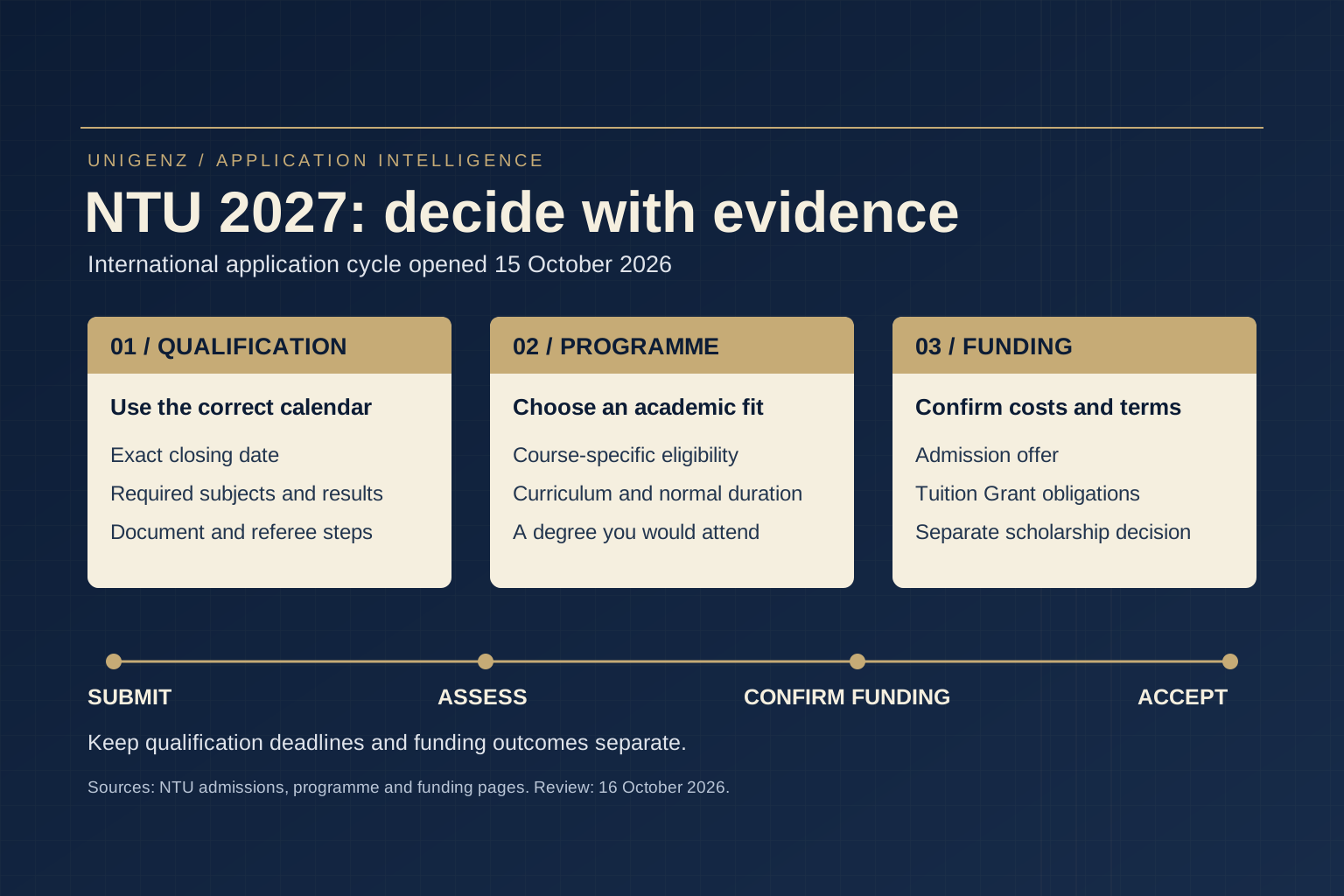
What opened this week, who is affected, and what to do next
Nanyang Technological University Singapore lists 15 October 2026 as the opening of its AY2027 international undergraduate application cycle, including the IB Diploma route. That scheduled opening falls within this week's review period. It is not evidence that NTU has just changed every admissions rule or introduced a new scholarship. The official pages were reviewed on 16 October; their application-opening date should not be confused with an article publication date.
The immediate audience is students preparing international school-leaving qualifications for undergraduate entry in 2027, together with families comparing Singapore with other destinations. Start by identifying the qualification route you will actually use. Then check programme prerequisites and construct a funding plan. Opening a form is useful only after those three decisions have been made coherently.
Use your qualification's calendar, not a universal March deadline
NTU's detailed table currently lists India Standard 12 and IB Diploma applications from 15 October 2026 to 19 March 2027. Several other routes, including Canadian provincial school qualifications, Australian qualifications and Indonesian Ijazah SMA, close on 20 January 2027. These examples demonstrate why a broad international-admissions banner cannot replace the qualification-specific table.
Our recommendation is to create a calendar with separate entries for the application, payment, supporting documents, additional course materials, scholarship submission and referee response. Record the official page and the date checked beside each entry. Do not assume that an administrative document-upload allowance extends an admissions or portfolio deadline. Where a time of day is not stated, obtain confirmation rather than inventing a midnight cut-off.
Nationality and curriculum are different variables. An Indian citizen studying the IB should follow the IB qualification instructions, while citizenship still affects funding and other conditions. Resolve any uncertainty about the correct form with admissions before submission. That prevents a family from organising months of preparation around the wrong deadline.
For India Standard 12, distinguish the application floor from competitiveness
NTU's India page currently specifies a minimum 93% average including English, excluding other language and technical subjects from that calculation. It says JEE-Main is unnecessary and does not improve selection chances, while a strong JEE-Advanced ranking is viewed favourably. These are eligibility and assessment statements, not an offer guarantee. Do not convert a minimum percentage into a predicted admission probability.
Students taking the 2027 board examinations can apply during the window. The general international-qualification instructions require relevant applicants awaiting results to enter actual results and upload the result slip within three days of release. They also state that no provisional offer is given before actual results are available. Assign responsibility for monitoring the board's release and completing the upload, including during travel or examinations.
Use the months before results to improve the evidence that is still within your control: subject mastery, a well-reasoned course shortlist and clear documentation. Paying for another certificate merely because an application has opened is a weak substitute for preparation that strengthens the student's academic readiness.
Check the programme before ranking it
Two details on the India page can overturn an otherwise attractive shortlist. For specified programmes requiring senior-level Mathematics, including Applied Computing in Finance and selected Science and Double Major programmes, Business Mathematics and Applied Mathematics at Standard 12 do not meet that prerequisite. Applicants whose final results arrive after 1 April of the application year are ineligible for LKCMedicine and the Renaissance Engineering Programme in that exercise. Check your expected results date before selecting either.
Engineering requirements also depend on the qualification. For Aerospace Engineering under International and Other Qualifications, the College of Engineering lists senior-high Mathematics and Biology, Chemistry or Physics, plus junior-high Physics where senior-high Physics was not taken; its stated first-semester Physics course requirement applies in that case. Read the exact row for your qualification instead of borrowing an A-level or IB rule.
For computing, our planning advice is to compare the mathematical foundation, systems content, data work and project opportunities of the actual degree. For engineering, connect the curriculum to the physical systems or technical problems the student wants to solve. A broader programme can preserve flexibility; a specialist programme can provide depth. Choose deliberately, and do not assume that a later internal transfer will repair an unsuitable initial choice.
Business applicants need a four-year comparison
Nanyang Business School's current guidance describes a four-year Bachelor of Business, with Single Major and Double Major options for incoming cohorts from AY2026/27. A Double Major remains one degree; it is distinct from a Double Degree in Accountancy and Business. The school encourages the normal four-year pathway, even though the stated minimum candidature is 3.5 years.
For a 2027 decision, compare the complete programme with alternatives over its normal duration. Include the extra year's housing and living costs, and examine what the curriculum and additional time make possible. The right question is whether the educational and professional opportunities justify the investment for this student. A shorter advertised alternative is not automatically better, and an extra credential label is not automatically worth its workload.
Ask which compulsory modules, major combinations and electives support the intended first roles. A student interested in quantitative finance should examine mathematical and analytical preparation; another targeting marketing should consider research, consumer analysis and communication. The same business degree can be used very differently. Programme selection should begin with that intended learning trajectory.
Treat admission, Tuition Grant and scholarship as separate outcomes
A place, a subsidised fee and a scholarship are different decisions. NTU's published fee table reviewed for this article is labelled AY2026/27; it should not be presented as a confirmed 2027 quotation. Obtain the applicable cohort schedule and the fee category in your offer. Compare subsidised and non-subsidised costs, and separate tuition from accommodation, living expenses, insurance, travel and compulsory charges.
The Nanyang Global Scholarship is open to all nationalities and supports outstanding full-time undergraduates. Its current terms cover subsidised tuition after the Tuition Grant, provide S$6,500 annual living support and up to S$2,000 annual hostel accommodation support, and include other specified benefits. Continued support requires the stated performance and conduct conditions, including a minimum 3.5/5.0 CGPA. Availability is competitive; current webpage benefits are not an award to an individual applicant.
Build a base budget using only support actually confirmed in writing. Then build a scholarship scenario separately. If the base case is unaffordable, the application may still be worth attempting, but classify enrolment as conditional on adequate funding. This prevents an admissions offer from becoming pressure to accept a financial plan the family never intended to carry.
Read the obligation behind the subsidy
The Nanyang Global Scholarship page says it adds no bond beyond the three-year obligation applying to Singapore PRs and international students under the MOE Tuition Grant Scheme. SMU's official explanation of the common scheme confirms that successful international grant recipients must work for a Singapore entity for three years after graduation; students declining or ineligible for the grant pay non-subsidised fees without that scheme's three-year obligation. Read the actual agreement and programme-specific terms before accepting.
For a family, the strategic trade-off is between lower upfront tuition and future flexibility. A student intending to build a career in Singapore may find the arrangement coherent. A student already committed to immediate postgraduate study elsewhere or returning home should obtain written guidance on the relevant obligations before relying on the subsidy. Do not assume a deferment or waiver will be available.
A bond does not supply a job or immigration permission. MOM states that after studies are completed and a Student's Pass expires, working in Singapore requires a work pass, which the employer must apply for. Evaluate the employment pathway independently. Likewise, our budgeting recommendation is to exclude hoped-for part-time earnings from the amount needed to make enrolment affordable.
Make the scholarship application an evidence exercise
NTU instructs applicants to complete admission first and then submit the separate scholarship application, with the scholarship deadline matching the admissions deadline. Its current process asks for the top three achievements and a 250-word essay, followed by a photograph and referee appraisal; the referee has seven days to submit. Selected scholarship types and award-specific instructions still need checking.
Our advice is to select achievements that show sustained responsibility, increasing difficulty and a result the student can explain. A project with a clearly described problem, method and limitation is more defensible than a long list of unexplained activities. Make the student's own contribution visible, especially in team work, and give the referee sufficient context and time without scripting their assessment.
Protect school performance while preparing the application. A family can easily spend disproportionate effort polishing a funding essay while neglecting examinations or prerequisite subjects. Set a modest weekly preparation allocation, maintain a checklist and stop adding activities solely to fill a form. The strongest evidence usually grows from work the student already values.
Use a decision file before making a commitment
We recommend one shared decision file rather than separate, inconsistent messages about eligibility and affordability. Mark each entry confirmed, pending or unsuitable. A pending funding decision should remain visible beside an attractive course, and an unresolved prerequisite should prevent the family from treating that course as a dependable option.
- Qualification: correct route, exact closing date, required results and a named person monitoring updates.
- Programme: subject eligibility, normal duration, curriculum fit and any selection or additional-material requirements.
- Finance: applicable cohort fees, total living costs, confirmed awards, subsidy obligations and currency contingency.
- Commitment: acceptance deadline, non-refundable exposure and a credible alternative if admission or funding fails.
What to do in the next seven days
First, identify the correct qualification page and save a dated checklist of its requirements. Second, reduce the course list to options that are academically eligible and genuinely attractive. Third, ask the school about results-release timing and referee availability. Fourth, prepare a funding comparison that keeps admission, subsidy and scholarship assumptions separate.
Keep other suitable universities active while NTU assesses the application. If another institution's deposit falls due first, compare the amount at risk with the value of preserving that option. Seek written deadline guidance where necessary, and never describe a pending scholarship as confirmed money. The opening of the window is an opportunity to organise a strong decision, not a reason to rush an irreversible commitment.
Applicant FAQs
Does everyone have until 19 March 2027? No. NTU's calendar has different qualification routes, including January closures. Use the row corresponding to the qualification being submitted.
Can a high percentage alone make NTU a safe choice? No. Meeting an application threshold does not establish a predictable chance of selection. Maintain an affordable shortlist of other programmes you would attend.
Does applying for admission automatically apply for scholarships? No. Complete the separate scholarship process and check that the referee stage is finished.
Should the family budget on receiving the Nanyang Global Scholarship? Only a confirmed award should reduce the base funding requirement. Keep a separate award-dependent scenario and define what would make acceptance affordable.
Admissions, visa and immigration rules can change. Always verify time-sensitive requirements on the relevant government and university websites before acting.
Primary sources reviewed
Official references
- NTU — AY2027 undergraduate application opening
- NTU — General admission requirements and qualification-specific windows
- NTU — India Standard 12 eligibility and programme restrictions
- NTU College of Engineering — Minimum subject requirements
- Nanyang Business School — Bachelor of Business FAQs
- NTU — Tuition fees and grants; displayed AY2026/27 schedule
- NTU — Nanyang Global Scholarship eligibility, benefits and terms
- SMU — Official explanation of the MOE Tuition Grant Scheme
- Singapore MOM — Student work permissions and post-study work-pass requirement
- NTU — Scholarship application process
Information reviewed on 16 October 2026. Time-sensitive rules should be checked again before application, deposit and enrolment.