
What changed, who is affected and what to do next
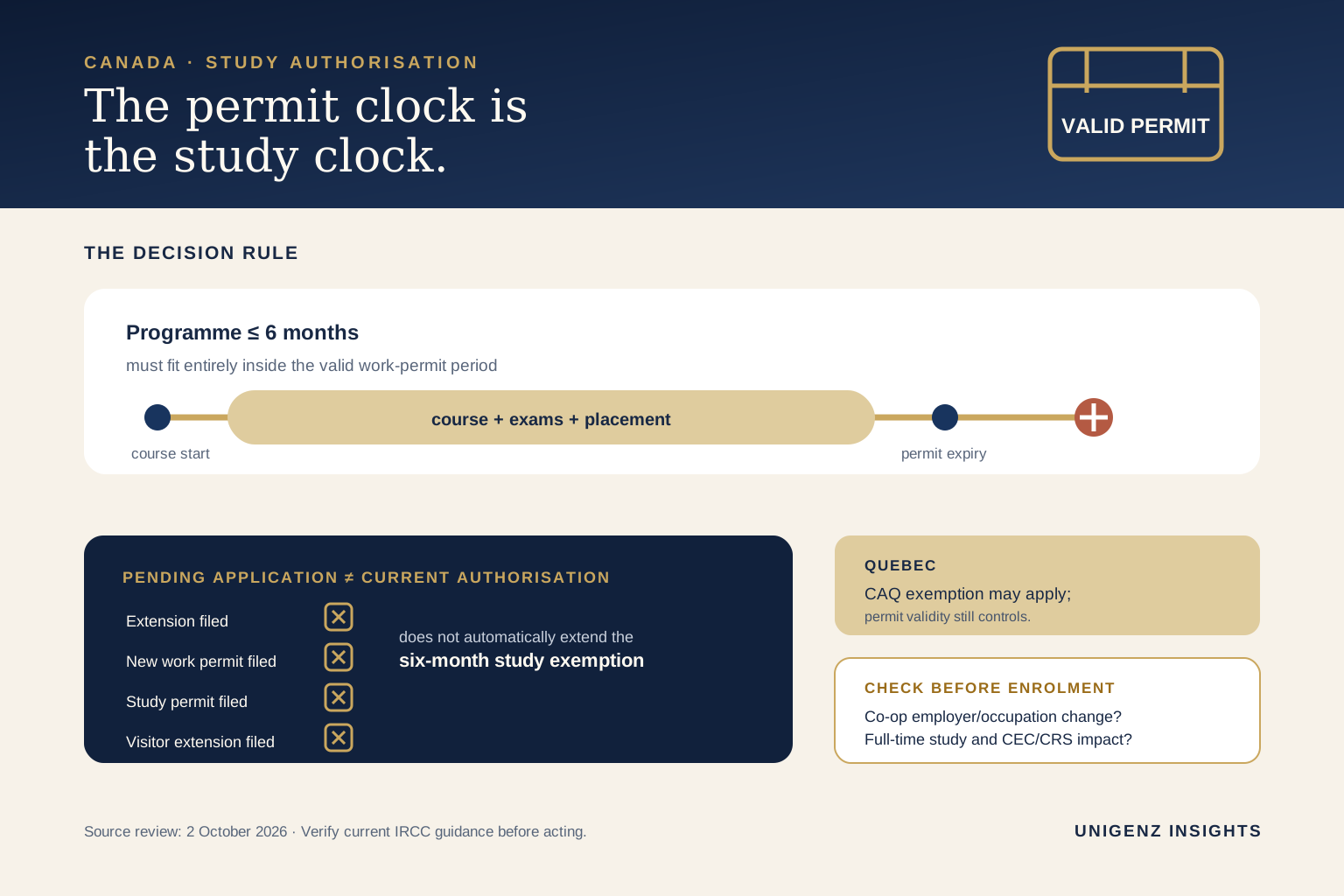
IRCC’s operational page, updated 1 October 2026, makes the expiry boundary explicit: a worker must have a valid work permit to use the temporary six-month study exemption. If the permit expires while studying, the person is no longer eligible—even if they have applied for a work-permit extension, a new work permit, a study permit or visitor status extension. The original policy became effective on 4 September 2026 and is scheduled to run until 31 December 2027.
This affects temporary foreign workers planning short study, employers agreeing schedule changes, institutions registering these learners and workers whose applications may not be decided before the current permit expires.
Put the permit expiry date beside the programme’s official end date. If the course runs beyond expiry, stop treating the exemption as a bridge and obtain current advice on the correct authorisation before continuing. Do not rely on a receipt, implied continuation or visitor extension as permission to study.
Publication date, effective date and current applicability
The temporary public policy took effect on 4 September 2026. The latest operational page shows 1 October 2026 as its page date. Those facts are different: 4 September is when the measure began applying; 1 October is when IRCC published the clearer expiry explanation. The policy is scheduled to expire on 31 December 2027, but may be revoked earlier.
The rule is different from the archived 2023 measure. Advice written for that earlier policy should not be used to infer that a pending 2026 application preserves today’s short-study authorisation. The current question is whether a valid work permit exists on the relevant study date and remains valid during the period of reliance.
The eligibility test is a timeline, not a checklist
The person must hold a valid Canadian work permit and the complete programme must be six months or less. The latest clarification adds the practical consequence that the programme cannot continue under this exemption after the permit expires.
Use four dates: current work-permit expiry; course start; official programme end including assessment; and any practicum, co-op or placement end date. The controlling date is the earliest point at which the exemption stops being available. Do not shorten a nine-month programme informally and call it six months.
Ask the institution for written confirmation of the credential name, duration, dates, delivery mode, enrolment intensity and placement. Keep that record with the work permit and registration evidence.
- Valid work permit on the study date
- Complete official programme of six months or less
- Programme and placement finish before permit expiry
- Written institutional dates and structure
Why a pending extension does not solve the study problem
A receipt number proves that an application was submitted; it does not turn an expired work permit into a valid work permit for this exemption. The updated IRCC guidance specifically warns that a person is not eligible to study under this policy after the work permit expires, even if they have applied for another work permit, a study permit or an extension of visitor status.
Before paying a non-refundable deposit, ask whether the course has a later intake, whether deferral is possible, what happens if the permit expires before completion and what authorisation the institution requires after expiry. Get the answer in writing.
Employer-specific and open permits still require planning
The temporary measure removes certain study-related permit conditions; it does not rewrite the employment relationship. A daytime course may be eligible but impossible under a schedule the employer has not agreed to change.
An employer-specific holder should check the authorised employer, occupation, location and hours. An open permit holder may have more flexibility, but the permit still has to be valid. Neither category can assume a pending renewal makes an expired document sufficient for continued study.
Put the course inside a buffer rather than exactly up to expiry. Allow time for examinations, a mandatory placement, results and institutional delay.
Quebec, co-op and full-time study are separate questions
Eligible workers in Quebec can use the federal policy and, under the parallel temporary measure, do not need a Quebec Acceptance Certificate for qualifying study. That does not create a right to continue after the federal work permit expires or remove other requirements.
If a co-op placement employer or occupation differs from the existing one, IRCC says an employer-specific work permit may be needed before the placement starts. Open-permit holders do not need a second permit solely for that reason if their permit remains valid and conditions allow the work.
IRCC also states that work experience gained while studying full-time under this policy does not count toward Canadian Experience Class eligibility or Canadian work-experience CRS points.
Programme-level decision framework
Before committing, score the course against authorisation fit, career fit, employer fit, immigration fit and financial fit. The course should be rejected or deferred if any one of these questions has no documented answer. A cheap certificate is not a good decision if it cannot be completed lawfully or is not recognised by the target regulator or employer.
- Does the programme and placement finish before expiry with a realistic buffer?
- Does the syllabus address a named licence, occupational requirement or promotion?
- Can schedule changes be agreed and does the permit still cover employment?
- Would full-time classification affect CEC or CRS planning?
- What are tuition, lost earnings, travel and deferral costs?
Common failure modes
The first mistake is confusing “I applied to extend” with “my work permit is still valid for this exemption.” Other failures include counting only classroom weeks, relying on an institution to make an immigration decision, changing work hours without agreement, assuming Quebec’s CAQ exemption removes all other conditions, using the old 2023 policy, treating a short programme as PGWP-eligible and assuming full-time work experience automatically helps Express Entry.
Practical next actions for the next seven days
Download the current permit and mark its expiry and conditions. Ask the institution for official programme and placement dates. Build a one-page timeline with a safety buffer. If dates cross expiry, pause registration and obtain current advice on the correct authorisation. If another application is pending, treat it as unresolved—not proof that the exemption continues. Confirm employer schedule changes in writing and record the possible CEC/CRS consequence before choosing full-time intensity.
The UniGenZ view
The 1 October clarification removes a dangerous ambiguity. The six-month exemption is a narrow tool for workers with a valid permit; it is not a bridge that stays open while another application waits in processing. The strongest choice is a recognised short programme with a finish date comfortably inside the permit’s validity and an employment plan that survives the schedule.
Admissions, visa and immigration rules can change. Always verify time-sensitive requirements on the relevant government and university websites before acting.
Primary sources reviewed
Official references
- IRCC — Workers studying without a study permit, updated 1 October 2026
- IRCC — Public policy allowing work-permit holders to study
- IRCC — Notice on temporary workers and short study
- MIFI — Studying in Quebec
Information reviewed on 2 October 2026. Time-sensitive rules should be checked again before application, deposit and enrolment.
Plan your next step
Read the complete Canada admissions and career guide, or explore the UniGenZ approach to programme selection.
Request Evaluation