
What changed, who is affected and what to do next
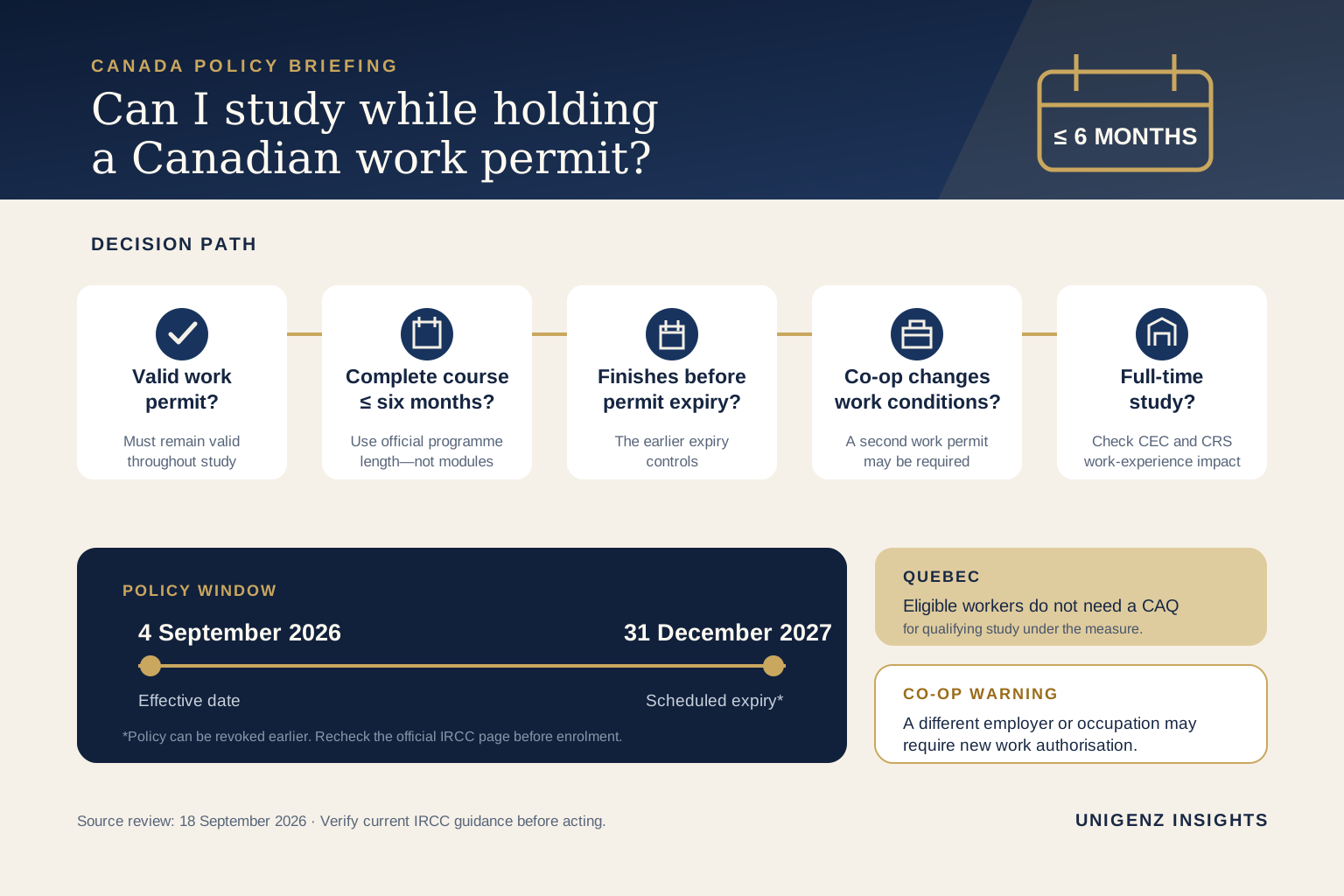
A Canadian temporary public policy effective 4 September 2026 allows a foreign national holding a valid work permit to undertake a course or programme lasting six months or less without obtaining a study permit. The exemption lasts only until the work permit expires, the policy expires or the measure is revoked. It is currently scheduled to expire on 31 December 2027.
The measure affects temporary foreign workers who want short, career-relevant education; employers supporting licensing or skills upgrading; and institutions admitting these learners. Quebec participants can also qualify and, under the parallel provincial measure described by IRCC, do not need a Quebec Acceptance Certificate for eligible study.
Before enrolling, confirm that the work permit remains valid for the whole course, obtain the institution’s written programme duration, identify any practicum or co-op component and assess the immigration consequences before switching to full-time study.
Publication date and effective date are different
The underlying public policy was signed on 5 August 2026 and states that it takes effect 30 days after signature. IRCC’s operational guidance confirms an effective date of 4 September 2026. The public-policy index was updated on 11 September 2026. Applicants should use the effective date when deciding whether an activity is authorised; the date an explanatory page was published or updated does not change when the exemption began.
The measure may be revoked before its scheduled expiry. Recheck the official page before registering, before starting classes and whenever renewing or changing immigration status.
This is also different from the broader 2023 measure, which has expired. The older policy could cover certain work-permit holders or applicants whose relevant application was received by 7 June 2023. The 2026 policy is framed differently: the worker must hold a valid work permit, and the permitted programme is limited to six months or less. Archived advice should not be used as the rule for a new enrolment.
The eligibility test has two essential parts
The foreign national must hold a valid work permit, and the complete course or programme must not be longer than six months. Authorisation ends when the work permit expires if that happens first. A person with four months left on a permit should not assume that a six-month course is covered for its full duration.
Read “six months or less” from the institution’s official programme structure—not the applicant’s preferred timetable. A nine-month certificate does not become eligible because a learner intends to complete selected modules in six months. Dividing a longer integrated programme into pieces may not change its actual duration or purpose.
Ask the institution to state the programme name, official length, start and end dates, delivery mode, enrolment intensity and whether the course is a standalone credential or part of a longer sequence. Keep the valid work permit, admission letter, course description and registration record together so the basis for enrolment is clear.
- Valid work permit throughout the intended period of study
- Complete official programme duration of six months or less
- Course completion before the permit expires
- Written institutional evidence of dates, structure and study intensity
Which programmes make strategic sense?
The policy is most useful where a short course closes a defined capability gap: professional-exam preparation, regulated-sector bridging content, technical software or equipment training, language development linked to workplace progression, supervisory qualifications, health-and-safety certification, project management or a compact university continuing-education credential.
A short programme is not automatically a good investment. Compare the syllabus with actual job descriptions, licensing standards and existing skills. Where a regulated profession is involved, confirm recognition directly with the relevant provincial regulator or professional body.
- Career relevance: the course addresses a named requirement for a target occupation, promotion or licence
- Recognition: the regulator, employer or professional body—not only the provider—values the credential
- Duration: the whole programme can finish before the work permit expires
- Delivery: attendance, assessment and employment obligations can realistically coexist
- Progression value: the course produces evidence such as a licence, assessed project, portfolio or examination result
Employer-specific and open permits require different planning
The exemption removes a study-permit step in eligible cases; it does not rewrite the employment contract. IRCC advises workers to agree changes with the employer if study requires reduced hours or another adjustment.
An employer-specific work-permit holder remains tied to the authorised employment conditions unless another rule or permit allows a change. Before enrolling in daytime or full-time study, examine work hours, leave provisions and any employer commitment linked to recruitment or training. Obtain written agreement where the programme alters the schedule.
An open work-permit holder may have greater employment flexibility, but still needs a valid permit throughout the relevant period. The safest plan aligns four dates: work-permit expiry, course start, course completion and any examination or placement date. If they do not fit comfortably, a study permit or later intake may be the cleaner route.
Quebec and co-op placements need separate checks
Workers in Quebec can use the federal policy from 4 September 2026. IRCC also states that an eligible worker studying under this measure does not need a Quebec Acceptance Certificate because a corresponding Quebec exemption took effect on the same date. This does not remove every provincial, institutional or professional-licensing requirement, especially if the learner later progresses into a longer course.
A programme may be academically eligible while its practical placement is not authorised. IRCC says a worker may need a new employer-specific work permit before a co-op placement if its employer or occupation differs from the one authorised by the existing permit. In that situation, a worker could hold the original permit and a second permit for the placement. An open work-permit holder does not need another permit solely for this reason if the open permit remains valid and its conditions allow the work.
- Is the placement compulsory for completion?
- Who is the legal employer during the placement?
- Does the occupation differ from the authorised occupation?
- Will the placement finish before the permit expires?
- Do medical-examination or sector restrictions affect the work?
Full-time study can change how work experience is counted
IRCC’s operational guidance contains the policy’s most consequential planning detail: when a worker studies full-time under this measure, work experience gained during that period does not count toward Canadian Experience Class eligibility and does not earn Canadian work-experience points under the Express Entry Comprehensive Ranking System.
That creates a genuine trade-off. Full-time study may accelerate a licence or career transition, but a worker accumulating qualifying Canadian experience could lose valuable months for CEC or CRS purposes. Do not assume that working normal hours makes the experience count if the person is also classified as studying full-time under the policy.
Confirm how the institution records enrolment intensity and retain documentation. Part-time study may have a different effect, but the official warning should not be converted into a promise that every part-time arrangement will qualify. CEC and CRS treatment depends on the applicable rules, work authorisation, hours, occupation and other facts. If permanent-residence timing matters, obtain individual advice from an authorised Canadian immigration professional.
When a study permit is still the better route
A study permit remains necessary or strategically preferable when the programme exceeds six months, the work permit expires before completion, the learner plans to progress directly into a longer qualification, or a future benefit depends on completing an eligible programme as a study-permit holder. It may also be cleaner when course attendance conflicts with employer-specific conditions or a required placement is not covered by the existing work authorisation.
Do not assume a short course creates post-graduation work-permit eligibility. This policy supports study while a person already holds a work permit; it does not convert a short programme into a PGWP-eligible credential or guarantee another permit after completion. Likewise, the qualification does not itself create permanent-residence eligibility. Its value comes from improving skills, licensing readiness or career evidence.
Common failure modes
The first mistake is enrolling in a programme described informally as “six months” without checking its official dates and structure. The second is overlooking the work permit’s earlier expiry. The third is assuming the existing permit covers a co-op employer or occupation that it does not authorise.
Other risks include reducing work hours without employer agreement, relying on the archived 2023 policy, treating a private certificate as regulator-recognised, or studying full-time without understanding the CEC and CRS consequence. There is also a financial risk: exemption from a study-permit application does not establish that the course is affordable or worthwhile. Calculate tuition, lost earnings, transport, examinations and materials against the realistic career gain.
A practical decision sequence
The policy creates a useful but limited bridge between employment and education. Its strongest use is not collecting another certificate; it is removing a defined barrier to progression. When programme duration, permit validity, work conditions, placements and immigration strategy align, it can support a credible move into higher-skilled work. When they do not, a study permit or different programme may provide a more stable route.
- Download the current work permit and record its expiry and conditions
- Obtain written programme duration, schedule and enrolment-intensity classification
- Confirm the complete programme fits before the work permit expires
- Identify practicum, co-op or employer changes and verify work authorisation
- Agree any schedule or contract changes with the employer before registration
- Model total cost against the specific licensing, promotion or career outcome
- Assess full-time study against CEC eligibility and CRS work-experience points
- Recheck the official IRCC policy immediately before the course starts
Admissions, visa and immigration rules can change. Always verify time-sensitive requirements on the relevant government and university websites before acting.
Primary sources reviewed
Official references
- IRCC — Workers studying without a study permit
- IRCC — Ministerial public policy signed 5 August 2026
- IRCC — Public-policy index, updated 11 September 2026
- IRCC — Archived 2023 public policy for comparison
Information reviewed on 18 September 2026. Time-sensitive rules should be checked again before application, deposit and enrolment.
Plan your next step
Read the complete Canada admissions and career guide, or explore the UniGenZ approach to programme selection.
Request Evaluation