
What changed, who is affected and what to do next
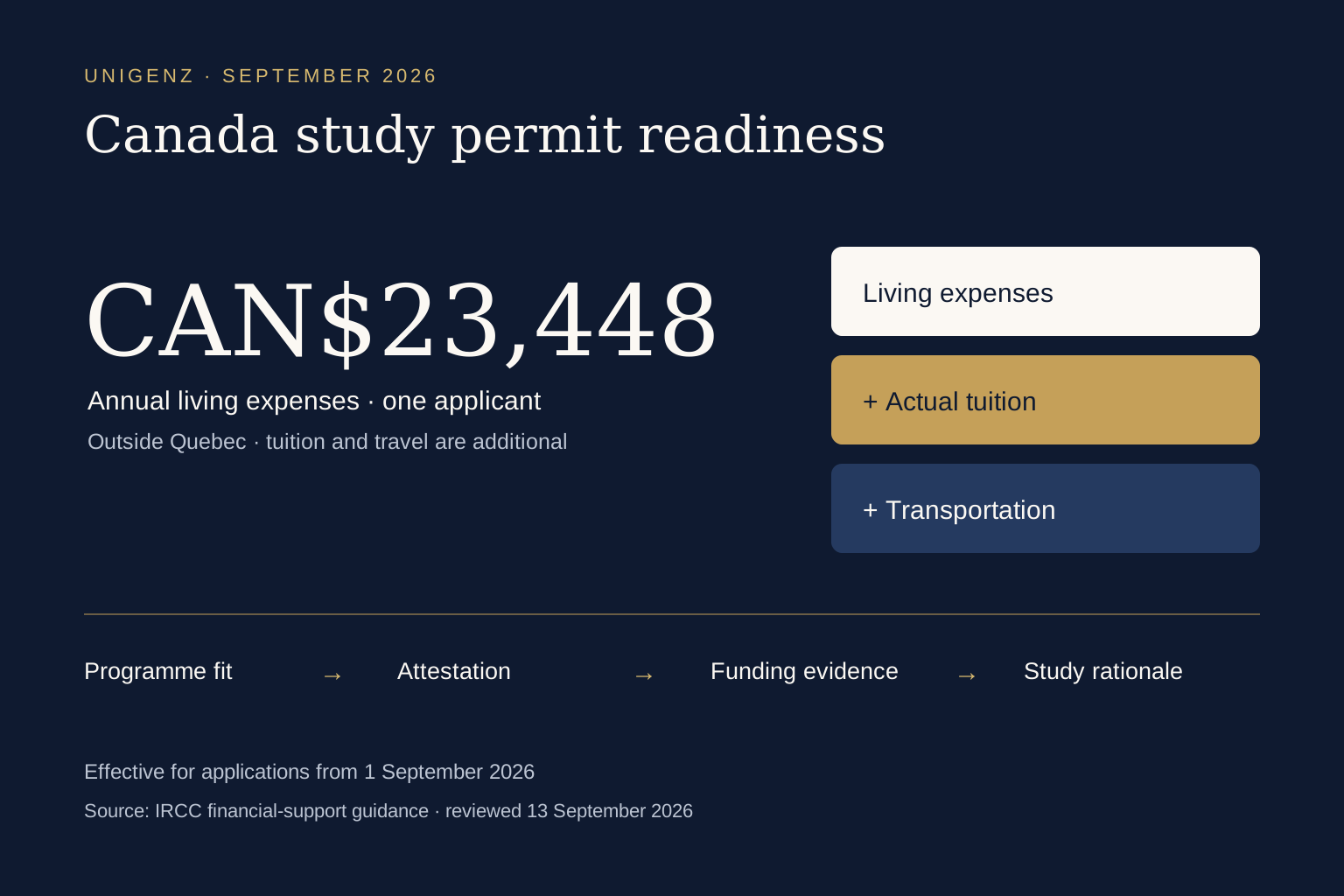
Canada increased the living-expense requirement for most new study-permit applications outside Quebec to CAN$23,448 for one applicant from 1 September 2026. Tuition and transportation are additional. Students submitting applications from that date should recalculate their finances, including accompanying family members, and update any evidence prepared using the previous CAN$22,895 figure.
This briefing concerns a change effective during the week ending 6 September 2026. The IRCC financial-support page displays a modification date of 28 August 2026; the new threshold took effect on 1 September. Publication or page-modification dates must not be confused with the date a rule starts applying. The 2026 permit targets and attestation system discussed below are existing context, not newly announced restrictions this week.
A credible application connects four decisions
Canada remains attractive to international applicants, but admission is only one stage of a viable plan. Programme choice, institutional requirements, available finances and post-study objectives need to support one another. A student can receive an offer and still have unresolved questions about the cost of completing the qualification, the documentation needed for a permit, or the value of the curriculum for a target career.
The immediate financial increase is CAN$553 for a single applicant. That is a modest change compared with many tuition bills, but it is a useful trigger to review the entire application. Simply adding that amount to an old funding calculation leaves larger weaknesses untouched: uncertain later-year support, unexplained transfers, an unsuitable course or an assumption that future employment will cover essential costs.
The threshold is a floor, not a complete budget
Start by separating living expenses, tuition and transport. Then add costs specific to the offer: compulsory equipment, insurance, professional examinations, deposits and any placement-related travel. A scholarship covering fees does not necessarily cover these other categories. The current IRCC financial-support guidance requires first-year resources and an explanation of how a programme lasting longer than a year will be funded.
As an illustrative calculation, a student with CAN$30,000 in first-year tuition and CAN$2,000 in return travel would begin with CAN$55,448 across those costs and the single-person living threshold. These tuition and travel figures are examples, not a university quotation. Replace them with the actual offer and travel estimate, and avoid counting the same prepaid cost or bank balance twice.
Build a separate affordability budget using the intended city, accommodation and course schedule. The regulatory minimum is not a promise that a particular lifestyle or housing choice will fit within it. A family should also stress-test exchange-rate movement and delayed graduation. An affordable first year followed by an unfinanceable second year is not a sustainable educational investment.
Accompanying family changes the calculation
For applications from 1 September 2026 outside Quebec, the annual living amounts are CAN$23,448 for one person, CAN$29,192 for two, CAN$35,888 for three, CAN$43,572 for four, CAN$49,419 for five, CAN$55,736 for six and CAN$62,054 for seven. Add CAN$6,318 for each further person. Count the applicant in the family size; tuition and transportation remain separate.
A student travelling with a spouse therefore needs a different financial model from a student travelling alone. If children may join later, plan the likely housing and family costs before committing. Do not assume that an accompanying partner will immediately find work or automatically qualify for work permission; those are separate questions requiring their own current eligibility checks.
Quebec uses its own financial framework for the Quebec Acceptance Certificate. Applicants to Quebec should follow the provincial requirements linked from IRCC rather than transferring the outside-Quebec table into their application.
Financial evidence should explain availability and continuity
Organise evidence around the actual funding sources. For parental support, connect the relationship, commitment and financial capacity. For a loan, read the disbursement conditions and confirm when money becomes available. For a scholarship, keep the award letter, duration and covered costs. A conditional award should not be treated as unconditional cash.
A practical file reconciles the tuition invoice, payments already made, available funds and remaining commitments. Explain significant transfers with their real supporting records. Recent money is not automatically invalid, but an unexplained deposit leaves a question that a documented sale, savings transfer or loan disbursement can answer. Never manufacture a financial history or temporarily borrow money merely to create a misleading balance.
Check the current visa-office instructions for the applicant’s location as well as the general guidance. Prepare the evidence early enough to resolve inconsistencies in names, account ownership and dates. This is editorial preparation advice; an individual permit assessment still depends on the applicant’s circumstances and the applicable rules.
Understand capacity without turning targets into odds
IRCC’s previously announced 2026 planning figures envisage up to 408,000 study permits: 155,000 for newly arriving students and 253,000 extensions or returning students. These figures describe system planning. They do not establish an individual applicant’s probability of approval, and they should not be presented as a fresh September cut.
Many applicants also need a provincial or territorial attestation letter. Exemptions apply, including qualifying degree-granting master’s and doctoral students at public institutions under current graduate guidance. Verify the exact programme and applicant category. An exemption from an attestation letter does not waive financial or other study-permit requirements.
Before paying a deposit, ask the institution whether it can issue the documents your category requires, what conditions must first be met and how deferral affects the offer. Institutional timing can matter even when the academic department still has places. Obtain written answers rather than relying on a general assurance that admission will lead to a permit.
Programme-level implications
Undergraduate applicants face a long funding horizon. For a four-year degree, identify plausible later-year resources and fee increases before accepting the first-year bill. Academic preparation should also match the chosen major. A student intending to study engineering needs to understand the mathematics prerequisites, accreditation and practical learning opportunities, not just the university’s overall reputation.
Master’s applicants should compare thesis-based and course-based structures. A funding package, research-supervisor commitment, placement opportunity and professional accreditation can materially change both the cost and value of the offer. Applicants in data science or artificial intelligence should inspect compulsory modules, assessment and access to projects. The subject label alone cannot establish whether a programme advances their existing skills.
College and applied-programme applicants should verify the exact credential, campus, institution and any relevant post-graduation work-permit conditions before paying. A shorter or cheaper programme may be sensible, but only if it provides useful progression from prior education and credible employer evidence. Where a field-of-study rule applies, check the official programme classification rather than inferring eligibility from a marketing title.
Separate work permission from career outcomes
Some eligible graduates may obtain a post-graduation work permit for up to three years, subject to the programme and the applicant meeting current requirements. That possibility is not a guarantee of employment or permanent residence. The duration available, eligibility conditions and later immigration options must be assessed separately.
Use four decision tests: academic fit, financial resilience, career relevance and immigration options. Would the qualification remain worthwhile if the student returned home after graduating? Can the family fund completion without relying on immediate earnings? Does the programme produce skills and evidence relevant to named roles? Which post-study options are actually supported by current official rules?
A programme that only makes sense if one immigration route remains unchanged is a fragile choice. A stronger plan develops skills transferable across employers and countries, and begins career preparation before arrival through technical foundations, communication and realistic research into target roles.
Common failure modes and the next six actions
The most avoidable mistakes are using the previous threshold, counting tuition-only funding as complete support, leaving large transfers unexplained, assuming attestation exemptions and depending on work to make the first year affordable. Another is treating an offer letter as proof that every immigration requirement has already been checked.
Use the following preparation sequence. It turns the financial update into a complete review of the proposed study plan rather than a last-minute correction to one number.
- Build the full budget: actual tuition, applicable family living amount, transport and course-specific costs.
- Confirm the submission date and the rules applying to the exact destination and applicant category.
- Ask the institution about attestation, offer verification, deposit refunds and deferral procedures.
- Reconcile funding documents, conditions, significant transfers and later-year resources.
- Check curriculum, progression, accreditation, placements and programme-specific work-permit eligibility.
- Write a study rationale that connects prior education, the chosen programme and realistic career objectives.
Frequently asked questions
Is CAN$23,448 the total budget? No. It is the annual living-expense minimum for one applicant outside Quebec under the new table. Tuition and transportation are additional.
Does receiving an offer before September preserve the previous amount? The table is tied to the application date, not the date of the admission offer. Check the current instructions for the application being submitted.
Does a tuition scholarship remove the need for other funds? No. Identify uncovered living, travel and family expenses and document how those will be paid.
Can future part-time work fund the initial application? IRCC requires financial capacity without relying on work in Canada. Treat potential earnings as supplementary when testing affordability.
Does admission guarantee a permit or permanent residence? No. Admission, a study permit, post-study work and permanent residence involve separate decisions and conditions.
The UniGenZ view
The September change is a practical reason to revisit the full financial and academic case. The best response is a transparent budget, a programme selected for its educational value and a career plan that can withstand uncertainty. Families should leave this process with a clearer understanding of what they are buying, how they will fund it and what evidence supports each important assumption.
Admissions, visa and immigration rules can change. Always verify time-sensitive requirements on the relevant government and university websites before acting.
Primary sources reviewed
Official references
- IRCC — Financial support (page dated 28 August; threshold effective 1 September 2026)
- IRCC — 2026 permit allocations (existing policy context)
- IRCC — Graduate student study permits
- IRCC — Post-graduation work permit eligibility
Information reviewed on 13 September 2026. Time-sensitive rules should be checked again before application, deposit and enrolment.
Plan your next step
Read the complete Canada admissions and career guide, or explore the UniGenZ approach to programme selection.
Request Evaluation